Showcasing

TrustNet

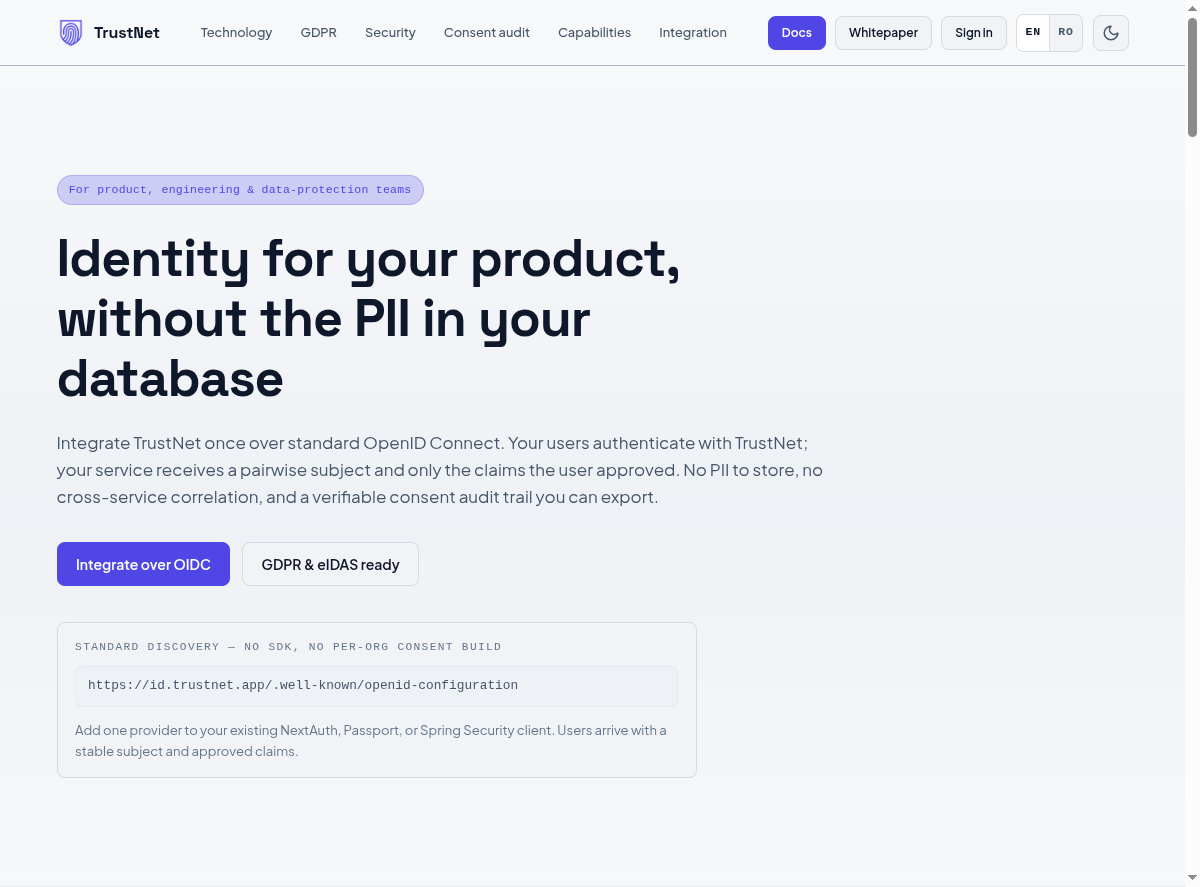
Identity for your product, without the PII in your database. TrustNet authenticates users over standard OpenID Connect and returns a pairwise subject plus only the claims each user approved — no personal data to store, no cross-service correlation, and a verifiable consent audit trail.
Ory Go HashiCorp Vault PostgreSQL RabbitMQ Redis React Caddy Cloudflare
Ory Go HashiCorp Vault
PostgreSQL RabbitMQ Redis
React Caddy Cloudflare

Featured

Identity without the PII

Most applications store names, emails and birth dates because authentication and identity representation are welded together. TrustNet separates them: your service stores a stable, pairwise pseudonymous subject and its own business data — nothing else.

When a rule needs a verified fact, TrustNet brokers it. You can require verified_phone, verified_address or verified_over_18 and receive true, while the number, address or birth date never crosses the boundary.

What your database holds

  • A pairwise subject — stable, but different for every service
  • Your permissions and your own business data
  • No names, emails, phone numbers or birth dates
Standard OpenID Connect — no SDK, no lock-in

TrustNet is a standard OpenID Connect provider. Point NextAuth, Passport, Spring Security or any OIDC client at the discovery document and integrate once — no proprietary SDK and no per-organization consent code to build.

Discovery is served at https://id.trustnet.app/.well-known/openid-configuration with pairwise subject types and RS256 ID tokens, so the wire protocol is plain RFC 6749 / OIDC Core and stays library-agnostic.

Why it matters

  • Drop-in support for existing OIDC clients
  • Deterministic pairwise subjects prevent cross-service correlation
  • No custom authentication code to own or maintain
Encrypted at rest, blind on lookup

Identity data is envelope-encrypted before it reaches the personas database, so a database dump yields ciphertext rather than identities. Lookups by value go through an HMAC blind index instead of a plaintext column: equality searches work, the value stays hidden.

The one secret that could correlate personas — the pairwise salt — lives in HashiCorp Vault and never in code, config or the database.

A consent trail you can prove

Every consent grant, access and revocation is written to an append-only, tamper-evident log. Entries record claim names, personas, clients and timestamps — never the values — so the audit trail can prove consent without becoming a second copy of the data.

The log is Merkle-anchored and exportable as CSV or JSON-LD for a DPO audit, with signed tree heads for integrity.

What an export contains

  • Claim names — never claim values
  • Persona, client and timestamp for each decision
  • A signed history your DPO can verify
Consent escalation without re-integration

Requirements change. When your service needs a claim the user has not shared yet, TrustNet runs the escalation flow: the user sees exactly the new claim and its reason, and approves or declines it. Already-granted claims stay granted.

Decline is a first-class outcome: you receive the claim as absent, never a partial leak, and the decision is recorded per claim and per service.

Secrets that never enter code or config

Envelope-encryption keys, the pairwise salt and signing keys live in Vault Transit. Runtime configuration references key identifiers, not raw cryptographic material, so there is zero key material on disk.

The Vault engine is network-isolated and reachable only by the Go services through restricted service tokens.

A durable event backbone

Auth events, disclosure reads and kill-switch webhooks move through RabbitMQ as durable, deduplicated messages that survive restarts. Consumers can retry without double-processing.

The result is at-least-once delivery with idempotent handlers — an audit pipeline that does not lose events when a service restarts.

Segregated data stores by design

TrustNet runs three segregated PostgreSQL databases — one each for Ory Hydra, Ory Kratos and personas — with no shared schemas. Consent and audit tables are append-only.

Redis handles sliding-window rate limits, session coordination and short-lived disclosure-read batches, keeping hot-path state out of the transactional databases.

Edge delivery with a small, auditable config

The public surface is served through Caddy with automatic TLS and a small, auditable reverse-proxy config, while Cloudflare provides edge caching, WAF rules and DDoS mitigation in front of the origin.

Every boundary enforces an explicit cryptographic contract: the browser never receives the pairwise salt, and internal calls to the identity engine use mTLS.

What’s your Project About?

We would love to know about your line of business and how we can help you grow!
Tell Us About Your Project